




Robert Serec
CEO · White Hydrogen Coalition

Noëlle Demole
Founder · Egidays

Cora Beth Enzor
Executive Director · Vanderbilt Health

Jonathan Melegrito
CFO · Purple Brand
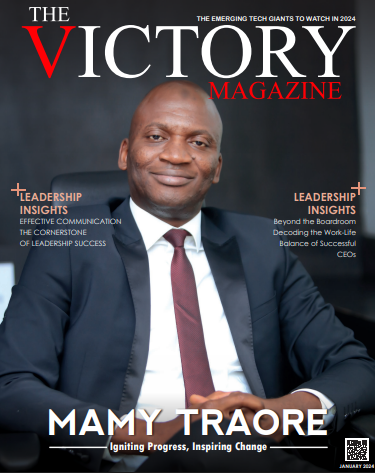
Mamy Traore
Chief Executive Officer, GUILAB SA
Mamy Traore is the founder and Chief Executive Officer of GUILAB SA, one of Guinea’s most ambitious technology ventures. Over five years, he has grown the company’s revenue by 340% while deliberately maintaining a minimal public profile a choice that has become something of a philosophy for how he leads.
Before founding GUILAB SA, Traore spent a decade working across technology and infrastructure roles in West Africa and Europe, building the operational and strategic instincts that now define his leadership style. He holds a degree in computer science and an executive MBA from a European business school.
Mamy Traore agreed to speak with The Victory Magazine on the condition that we focus on the work, not the person. He spent the first ten minutes of our conversation redirecting every personal question toward GUILAB SA. Then, gradually, the story of the company and the story of the man became indistinguishable.
Because I noticed early on that the time I spent on visibility was time I was not spending on the company. And I had to make a choice about which one I was actually building.
There’s a real market for the idea that a CEO’s public profile and their company’s performance are correlated. I don’t believe the data supports that. What I have seen, in the companies I have studied and the executives I admire, is that the most enduring builders are almost always the ones who are relentlessly focused on one thing and that thing is the organisation itself, not the story of the organisation.
“I decided very early that I would only speak publicly when I had something genuinely new to say. That has meant long silences. But when I do speak, people seem to listen differently.”
Slowing down when everyone around me said we needed to accelerate. Around our third year, we had significant investor interest and real momentum. The conventional playbook said: raise capital, expand headcount, enter new markets quickly.
We did none of those things. We spent six months consolidating what we had fixing the things that were quietly breaking under the growth pressure, investing in the team’s depth rather than its size, and saying no to opportunities that were genuinely attractive but that were not the core thing we were building.
The investors who were patient with us in that period have made exceptional returns. The ones who wanted speed left. I am at peace with both outcomes.
In our fourth year, I realised that the company had outgrown the version of me that had founded it. The skills that got us from zero to where we were – the scrappiness, the willingness to do everything personally, the instinct to centralise decisions – were becoming liabilities.
I spent three months genuinely examining whether I was the right person to take GUILAB to the next stage. I spoke to mentors. I spoke to people who had no reason to be kind to me about the answer. And I came to the conclusion that I could be the right person – but only if I fundamentally changed how I operated.
So I rebuilt my role from scratch. I brought in a COO who was better at operational execution than I would ever be. I restricted my own decision-making authority in areas where I was a bottleneck. It was one of the most difficult things I have done – and the most important.
“The skills that get you from zero to somewhere are often the same ones that prevent you from getting to the next place. The leaders who understand that – and act on it – are rare.”
That the context you are building in is not a disadvantage to be overcome. It is the thing that gives your company its particular character and resilience. The businesses that survive difficult environments develop capabilities that companies in easier environments never need to build – and those capabilities become extraordinary competitive advantages when the environment changes.
Build the thing that is native to where you are. Don’t import a model from somewhere else and wonder why it doesn’t fit. The global market is increasingly interested in what comes from Guinea, from Kenya, from Indonesia, from Brazil not in spite of its origin, but because of it.
And be patient. Genuinely, structurally patient. Not optimistic patience – which is just hoping things go well. Strategic patience: the kind where you are building something specifically designed to outlast you.
12 leaders profiled across 9 countries. The definitive CEO edition of 2026.
Your story belongs on a global stage.
Please fill this form to read Magazine
Please fill this form to read Magazine
Please fill this form to read Magazine
Please fill this form to read Magazine
Please fill this form to read Magazine
Please fill this form to read Magazine
Please fill this form to read Magazine
Please fill this form to read Magazine
Please fill this form to read Magazine
Please fill this form to read Magazine
Please fill this form to read Magazine
Please fill this form to read Magazine
Please fill this form to read Magazine
Please fill this form to read Magazine
Please fill this form to read Magazine
Please fill this form to read Magazine
Please fill this form to read Magazine
Please fill this form to read Magazine
Please fill this form to read Magazine
Please fill this form to read Magazine
Please fill this form to read Magazine
Please fill this form to read Magazine
Please fill this form to read Magazine
Please fill this form to read Magazine
Please fill this form to read Magazine
Please fill this form to read Magazine
Please fill this form to read Magazine
Please fill this form to read Magazine
Please fill this form to read Magazine
Please fill this form to read Magazine
Please fill this form to read Magazine
Please fill this form to read Magazine
Please fill this form to read Magazine
Please fill this form to read Magazine
Please fill this form to read Magazine
Please fill this form to read Magazine
Please fill this form to read Magazine
Please fill this form to read Magazine
Please fill this form to read Magazine
Please fill this form to read Magazine
Please fill this form to read Magazine
Please fill this form to read Magazine
Please fill this form to read Magazine